
Clean Affordable Energy
The Role of Women Entrepreneurs in Africa’s Energy Transition
Sep
The Role of Women Entrepreneurs in Africa’s Energy Transition
Africa’s energy transition will not be complete if women are only seen as beneficiaries. They must also be recognised as entrepreneurs, innovators, technicians, investors, distributors, decision-makers and leaders shaping the continent’s clean energy future.
Africa stands at a defining moment in its energy journey.
Across the continent, millions of people still lack reliable access to electricity, while communities that are connected often face high costs, unreliable supply and limited opportunities to use energy productively. As Africa works to expand electricity access and transition toward cleaner energy systems, one group has an enormous but still underused role to play: women entrepreneurs.
Women are already at the heart of many African communities. They run businesses, manage household energy needs, support families, organise communities and create livelihoods in places where formal infrastructure is limited.
Increasingly, they are also becoming solar entrepreneurs, technicians, distributors, clean-cooking innovators, energy retailers, engineers, founders and community energy leaders.
Their participation is not simply a question of gender equality.
It is an economic opportunity—and an essential part of building an energy transition that actually reaches the people who need it most.
Africa’s Energy Transition Is Also an Economic Transition
The energy transition is often described in terms of solar panels, batteries, mini-grids, electric vehicles and other technologies.
But technology alone cannot transform Africa’s energy system.
The transition is ultimately about people, businesses, communities and economic opportunity.
According to the International Energy Agency (IEA), around 600 million people in sub-Saharan Africa lacked access to electricity in 2024, representing about 47% of the population. Around 80% of people without electricity access live in rural areas, making decentralised solutions such as mini-grids and solar home systems particularly important. [1]
The scale of the challenge creates an equally significant opportunity.
Africa needs entrepreneurs who can take clean energy technologies and make them accessible, affordable and useful in real communities.
Women can play a critical role in doing exactly that.
They can help bridge the gap between technology and the customer, between energy companies and communities, and between investment and local economic development.
Why Women Entrepreneurs Matter in the Clean Energy Economy
Women are not newcomers to Africa’s energy economy.
For generations, women have been responsible for many household energy decisions—collecting fuel, cooking, managing household energy expenditure and finding ways to keep families functioning when electricity is unavailable.
Yet the people most affected by energy poverty have not always been given an equal opportunity to shape the systems designed to solve it.
This represents a major missed opportunity.
Women entrepreneurs bring local knowledge, community relationships, consumer insight and business creativity that can make energy solutions more responsive to local realities.
A woman running a small shop in a rural community may understand exactly why a household cannot afford a solar system upfront.
A female technician living in the community may know which households need productive-use appliances, where installations are most practical and how to build trust with customers.
A woman entrepreneur operating a clean-cooking business may understand the daily realities of mothers, food vendors and small businesses better than a distant supplier.
This proximity matters.
Energy access becomes more sustainable when communities are not simply treated as markets, but as partners.
Women Are Moving Across the Renewable Energy Value Chain
Women’s participation in renewable energy should not be limited to selling solar lanterns.
The clean energy economy offers opportunities across the entire value chain.
Women can participate in:
- Solar product distribution
- Solar installation and maintenance
- Energy retail and last-mile distribution
- Mini-grid development
- Clean cooking enterprises
- Solar-powered agriculture
- Productive-use energy
- Energy financing and PAYGo services
- E-mobility
- Solar-powered refrigeration
- Energy efficiency
- Manufacturing and assembly
- Energy technology
- Digital energy platforms
- Research and innovation
- Consulting and project development
- Community engagement
- Policy and advocacy
IRENA’s research shows that renewable energy already employs women at higher rates than several traditional energy sectors. Yet women remain underrepresented in technical and leadership positions. Women account for about 32% of full-time renewable energy employment globally, but only 28% of STEM-related positions, 22% of medium-skilled roles such as installation and construction, and 19% of senior management or board positions. [2]
The message is clear:
The opportunity exists, but women are still not participating at the level their potential warrants.
The Rise of Women in Decentralised Solar Energy
The decentralisation of energy systems could be particularly important for women entrepreneurs.
Africa does not need to wait for every remote community to receive a traditional grid connection before people can benefit from modern energy.
Solar home systems, mini-grids, solar appliances and other distributed technologies can bring electricity and productive energy services closer to rural households and businesses.
IRENA estimates that more than 300,000 people were directly employed in the decentralised solar PV sector across Ethiopia, India, Kenya, Nigeria and Uganda in 2023. However, women represented only a small portion of that workforce and continued to face barriers involving training, mobility, workplace flexibility, social expectations, safety and customer perceptions. [3]
This is where entrepreneurship becomes especially powerful.
A woman does not have to wait for a large energy company to create a job for her.
With the right financing, training, technology and market access, she can become part of the energy distribution network herself.
She can become the person who takes solar technology from the warehouse to the household.
She can become the technician who installs it.
She can become the entrepreneur who finances it.
She can become the community leader who explains how to use it.
And she can become the business owner who employs the next generation of women.
The Financing Gap Is One of the Biggest Obstacles
If women are going to lead Africa’s energy transition, they need more than encouragement.
They need capital.
This is one of the most persistent barriers facing women entrepreneurs.
A 2025 African Development Bank and Climate Investment Funds initiative examining women in renewable energy in Uganda, Kenya and Rwanda found that women led less than 20% of renewable energy businesses in those countries while accessing only 7% of available commercial capital. The research identified barriers including limited collateral, gender bias in lending and a shortage of financial products designed around women’s businesses. [4]
These barriers become even more significant for entrepreneurs working in rural energy markets.
A rural energy business may require inventory, transportation, technical equipment, working capital, customer financing and after-sales support before revenue becomes predictable.
Traditional lenders may see this as risky.
But what looks like risk from a conventional financial perspective can also represent untapped market opportunity.
This is why Africa needs financing models that understand the realities of women-led energy businesses.
These could include:
- Gender-responsive investment funds
- Concessional loans
- Grants for early-stage innovation
- Credit guarantees
- Results-based financing
- Cash-flow-based lending
- Asset financing
- PAYGo business models
- Blended finance
- Working-capital facilities
- Equipment leasing
- Affordable customer financing
The IEA has similarly highlighted the need for targeted financial solutions for women-owned businesses in electricity-access supply chains, including dedicated funds, improved credit assessment tools and financial incentives. [1]
Women Can Help Solve the Last-Mile Energy Challenge
One of Africa’s biggest energy challenges is not simply producing electricity.
It is getting affordable, reliable energy to the last mile.
Remote villages can be expensive and difficult to serve. Customers may have irregular incomes. Roads may be poor. Conventional distribution networks may not reach them.
This is where community-based entrepreneurship can make a difference.
Women who live in or have strong relationships with underserved communities can serve as trusted intermediaries between energy providers and customers.
They can help companies understand local demand.
They can educate customers.
They can provide after-sales support.
They can identify financing needs.
They can collect feedback.
And, importantly, they can create employment for other women.
The World Bank has documented how distributed renewable energy can create economic opportunities alongside electrification. In Nigeria, distributed renewable energy initiatives have helped electrify more than 11,000 women-owned enterprises, demonstrating how energy access can support women not only as consumers but as business owners. [5]
This is the deeper connection between energy access and entrepreneurship.
Energy powers businesses.
Businesses create income.
Income increases the ability to invest in better energy services.
And local entrepreneurs help make energy systems more sustainable.
From Energy Consumers to Energy Leaders
For decades, women in many African communities have been viewed primarily as energy consumers or beneficiaries.
That narrative needs to change.
Women can be energy leaders.
Consider the difference between these two approaches:
Approach one:
Provide a woman with a solar lantern.
Approach two:
Train that woman to become a solar entrepreneur who sells, installs, finances and services clean energy products in her community.
The first addresses an immediate need.
The second can create a lasting economic opportunity.
This distinction is at the heart of a truly inclusive energy transition.
The African Development Bank’s recent work reinforces this shift. Its 2026 gender-transformative renewable energy strategy for The Gambia calls for women to be recognised not merely as beneficiaries, but as equal partners in the country’s energy transition. The report identifies finance, training, markets, land, mobility, cultural norms and STEM participation among the barriers that must be addressed. [6]
That principle should extend across Africa.
Women Entrepreneurs Can Make the Energy Transition More Community-Centred
Clean energy technologies do not automatically produce inclusive development.
The way those technologies are introduced matters.
A community may receive solar infrastructure, but if local people cannot afford the service, maintain the equipment or generate income from the electricity, the impact may remain limited.
Women entrepreneurs can help make energy interventions more locally relevant.
They often understand the intersection between energy, household income, agriculture, education, healthcare and small business.
For example, reliable solar power can enable a woman to:
- Keep a shop open after sunset
- Refrigerate food or medicines
- Charge phones for customers
- Operate a sewing machine
- Process agricultural products
- Run a small restaurant
- Power irrigation
- Study or support children’s education
- Access digital financial services
- Expand a home-based business
The energy transition therefore becomes much bigger than replacing fossil fuels with renewable electricity.
It becomes a pathway to economic empowerment.
Women and the Future of Green Jobs in Africa
The energy transition is also a jobs transition.
IRENA and the International Labour Organization estimate that global renewable energy employment reached at least 16.6 million jobs, according to their 2025 annual review. At the same time, IRENA continues to identify persistent barriers preventing women from fully participating in the sector. [7]
For Africa, the employment opportunity is substantial.
IRENA has estimated that an ambitious energy-transition pathway could create millions of additional jobs across the African economy, including renewable energy, energy efficiency, manufacturing, services, infrastructure and supporting industries. [8]
The question is not whether Africa will create green jobs.
The question is:
Who will have access to those jobs—and who will own the businesses creating them?
Women must be part of the answer.
Training women only for entry-level positions is not enough.
Africa needs women who own solar companies.
Women who develop energy technologies.
Women who manage distribution networks.
Women who raise investment.
Women who lead energy policy.
Women who build energy platforms.
Women who employ other women.
And women who sit at the tables where Africa’s energy future is being designed.
What Needs to Change?
Unlocking the potential of women entrepreneurs requires action from governments, investors, development organisations, energy companies, educational institutions and communities.
1. Make finance more accessible
Financial institutions should develop products that recognise the realities of women-led businesses, particularly early-stage and rural enterprises.
2. Invest in technical skills
Women need access to practical training in solar installation, electrical systems, battery technologies, digital tools, business management and emerging energy technologies.
3. Build stronger women-led energy networks
Entrepreneurs need access to mentors, suppliers, customers, investors and peers.
4. Open the entire energy value chain
Women should not be restricted to sales and administration. They should have opportunities in engineering, installation, operations, manufacturing, software, project development and leadership.
5. Create gender-responsive procurement
Governments, development institutions and large energy companies can deliberately include qualified women-led enterprises in supply chains and energy projects.
6. Design energy policies with women—not just for women
Women entrepreneurs should have a voice in energy policy, electrification planning and investment decisions.
7. Measure more than the number of women trained
Success should be measured through business creation, revenue growth, jobs created, assets owned, financing accessed, customers served and leadership positions achieved.
Training is important.
Economic power is the outcome that matters.
Greenargy: Putting Women at the Centre of Community Energy Access
Across Africa, the future of energy access will increasingly depend on innovative, community-driven models that connect technology with people.
At Greenargy, a Digital Energy Platform, we believe clean energy access should create opportunities as well as provide electricity.
Our approach connects underserved communities with clean energy solutions through community-based distribution, digital access, flexible financing, mobile money payments, installation, maintenance and local support.
Women are an important part of this ecosystem.
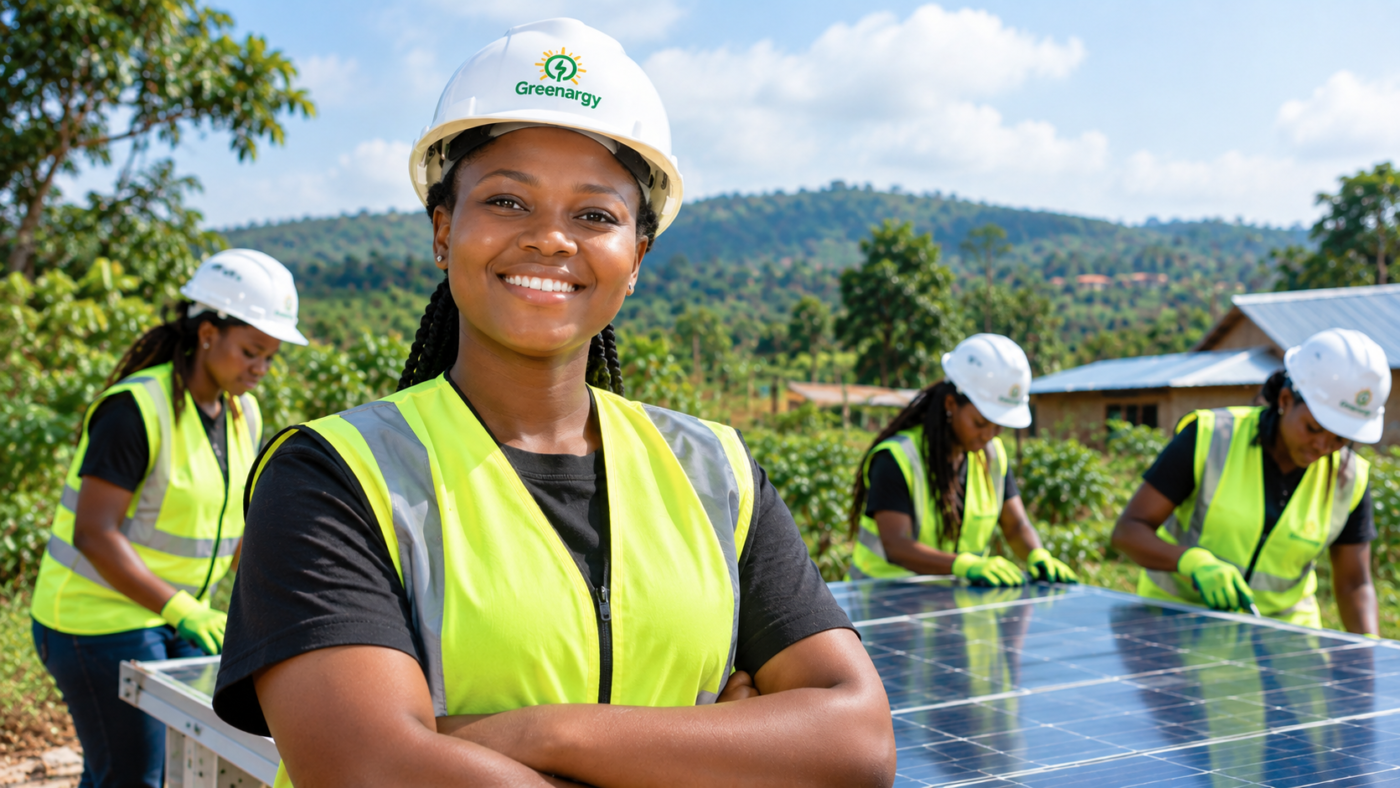
Through community solar agents and technicians, women can become more than customers of the energy transition. They can become participants, entrepreneurs and economic multipliers within it.
This model recognises an important reality:
The person who understands a community can often be one of the most powerful people to deliver change in that community.
When women are equipped with skills, technology, financing and market opportunities, a single entrepreneur can influence hundreds of households.
And when those entrepreneurs are connected through a wider digital energy platform, their collective impact can grow even further.
The Future of Africa’s Energy Transition Must Be Inclusive
Africa cannot afford an energy transition that leaves half of its population on the sidelines.
The continent needs more electricity, but it also needs more businesses, jobs, innovation and local ownership.
Women entrepreneurs sit at the intersection of all four.
They can help expand clean energy access while creating livelihoods.
They can turn energy infrastructure into productive economic activity.
They can bring community knowledge into technology design.
They can create jobs for other women and young people.
And they can help ensure that Africa’s clean energy future is not something imported into communities, but something created with and by those communities.
The energy transition should therefore be measured not only by megawatts of renewable capacity installed.
It should also be measured by how many women own energy businesses, how many women become technicians and engineers, how many women access capital, how many jobs women create, and how many communities become more economically resilient because women are leading the change.
Africa’s energy future needs more than new infrastructure.
It needs new leadership.
And women entrepreneurs are already showing that they can lead.
Frequently Asked Questions
What role do women entrepreneurs play in Africa’s energy transition?
Women entrepreneurs help expand renewable energy access, create jobs, distribute clean energy technologies, develop innovative business models and connect energy solutions with the needs of local communities. They can participate throughout the energy value chain, from distribution and installation to technology, financing, project development and leadership.
Why are women important to Africa’s clean energy transition?
Women are disproportionately affected by energy poverty while also playing major roles in household energy management and community economies. Their participation can bring valuable local knowledge, strengthen last-mile distribution and create additional economic opportunities.
What are the biggest barriers facing women entrepreneurs in renewable energy?
Major barriers include limited access to finance and collateral, gender bias, insufficient technical training, restricted professional networks, cultural expectations, mobility and safety challenges, and underrepresentation in STEM and leadership positions.
How can women access opportunities in renewable energy?
Women can enter the sector through technical training, entrepreneurship programmes, solar distribution, installation and maintenance, clean cooking, energy financing, digital energy services, productive-use technologies, energy consulting and renewable energy project development.
How can investors support women-led energy businesses?
Investors can provide patient capital, blended finance, grants, guarantees, working capital, technical assistance and investment products specifically designed to address the barriers faced by women-led businesses.
Why is women’s entrepreneurship important for rural energy access?
Women entrepreneurs living in or connected to rural communities can help overcome last-mile challenges by building trust, understanding local demand, distributing products, providing customer support and creating locally rooted businesses.
What is the future of women entrepreneurs in Africa’s energy sector?
The opportunity is expanding as Africa invests in renewable energy, decentralised electricity, clean cooking, energy efficiency, e-mobility and digital energy services. The priority now is to ensure women have equal access to the capital, skills, technology, markets and leadership opportunities required to capture that growth.
Discover how women entrepreneurs are shaping Africa’s energy transition through renewable energy, innovation, job creation, clean energy access and community-led solutions.
Africa’s energy transition is too important to be designed without women.
Women entrepreneurs are not simply potential beneficiaries of the clean energy economy. They are builders of businesses, creators of jobs, innovators of solutions and leaders of communities.
If Africa wants an energy transition that is affordable, inclusive, locally owned and economically transformative, investing in women entrepreneurs must move from the margins of energy policy to the centre of it.
The future of African energy should not only be powered by clean technology. It should be powered by African entrepreneurs—including the women already leading change in their communities.
