
Clean Affordable Energy
Why Millions of Africans Still Lack Reliable Access to Electricity
Sep
Why Millions of Africans Still Lack Reliable Access to Electricity
Africa has enormous energy potential. It has abundant sunshine, rivers, wind resources, biomass, and a rapidly growing population. Yet hundreds of millions of Africans still live without electricity—and millions more live with electricity that is too expensive, unreliable, or unavailable when they need it most.
In 2024, around 560 million people in Sub-Saharan Africa still lacked access to electricity, according to the latest Tracking SDG 7: The Energy Progress Report. Globally, 655 million people remained without electricity. Sub-Saharan Africa therefore continues to carry the overwhelming majority of the world’s electricity-access gap.
This is more than an energy problem.
It is a problem of education, healthcare, jobs, digital inclusion, agriculture, entrepreneurship, household income, and opportunity.
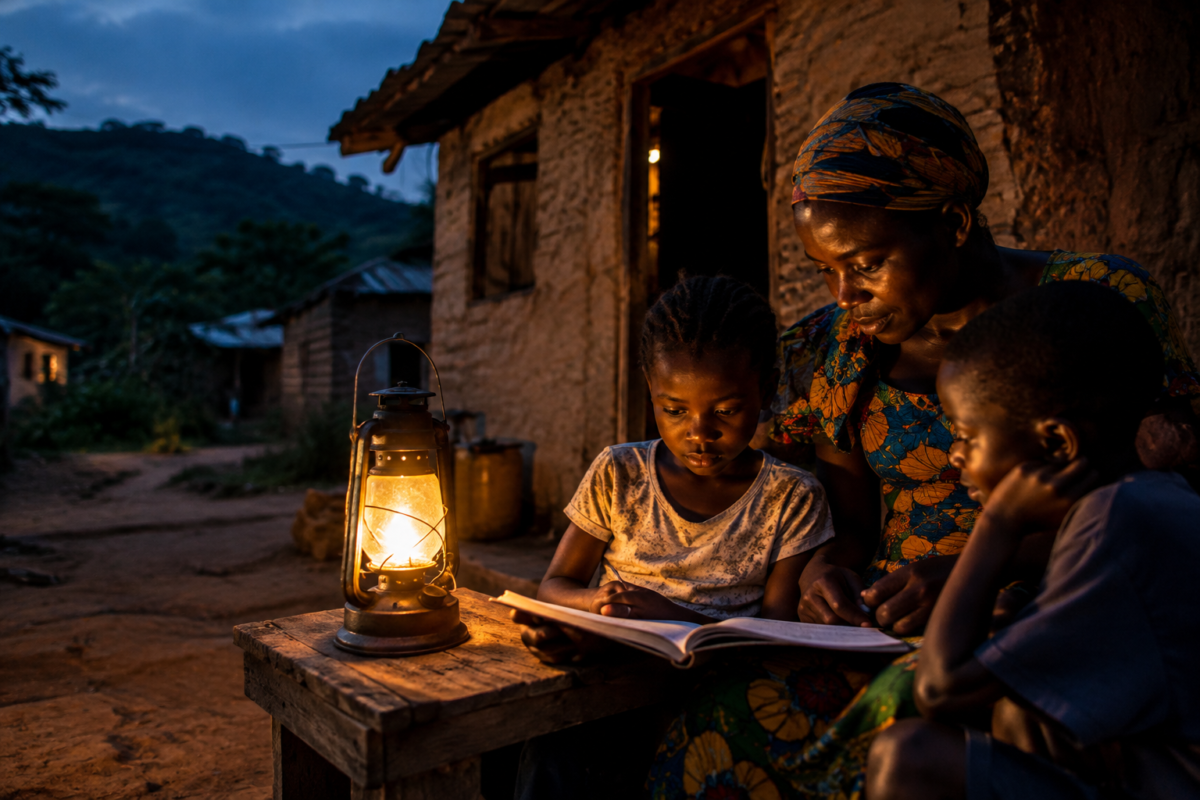
For a child trying to study after sunset, electricity can mean the difference between reading under a clean light and relying on a smoky kerosene lamp.
For a rural clinic, it can determine whether vaccines can be safely stored and medical equipment can operate.
For a farmer, electricity can enable irrigation, refrigeration, processing, and longer productive hours.
For a small business, reliable power can mean the difference between growing and simply surviving.
So why does this gap persist?
The electricity-access problem in Africa is more complicated than it looks
At first glance, the solution might appear straightforward: build more power plants, extend electricity grids, and connect more households.
But Africa’s electricity challenge is not simply a shortage of electricity generation.
It is a combination of distance, affordability, infrastructure, financing, population growth, reliability, policy, and the economics of serving dispersed rural communities.
The latest IEA analysis estimates that around 600 million people across Africa still live without electricity, with electrification struggling to keep pace with population growth. Fewer than 19 million people gained access in both 2023 and 2024, compared with about 23 million in 2019.
In other words, Africa is making progress—but not fast enough.
And the communities furthest from the grid are often the communities facing the greatest barriers.
1. Rural communities are harder and more expensive to reach
One of the biggest reasons millions of Africans remain without electricity is geography.
Many underserved communities are located far from existing electricity infrastructure. Houses may be scattered across large rural areas, roads may be poor, and population density may be too low to make conventional grid expansion economically attractive.
This creates a difficult equation.
Extending a traditional electricity grid requires investment in generation, transmission lines, substations, distribution networks, poles, transformers, meters, maintenance, and connections to individual households.
For a densely populated city, those investments can serve thousands or millions of customers in a relatively small area.
For a remote village, the same infrastructure may require significant investment to serve a much smaller customer base.
This is why traditional grid expansion alone cannot solve Africa’s electricity-access challenge.
The World Bank notes that most people without electricity live in remote areas, conflict-affected locations, or low-income regions where extending conventional infrastructure is particularly difficult.
This is where decentralized energy becomes increasingly important.
Solar home systems, mini-grids, standalone systems, and other distributed renewable-energy technologies can bring electricity closer to where people live instead of waiting for the national grid to arrive.
2. Population growth is outpacing electrification in many places
Africa is experiencing rapid population growth.
That creates enormous economic potential—but it also means that providing electricity to everyone requires connecting new households faster than the population is growing.
This is one reason why the number of people without electricity can remain stubbornly high even when millions of new connections are made.
In Sub-Saharan Africa, 35 million people gained access to electricity in 2023, but the number of people without electricity fell by only about 5 million because population growth absorbed much of the progress.
This creates an uncomfortable reality:
Connecting millions of people is progress. But if millions more are being born into communities without electricity, the access gap can remain enormous.
The solution therefore needs to be faster, more scalable, and more adaptable.
3. Electricity is still unaffordable for many households
Having electricity infrastructure nearby does not automatically mean a household can afford electricity.
Families may face connection fees, wiring costs, meters, appliances, monthly bills, or the upfront cost of solar equipment.
For households living on limited and irregular incomes, even relatively small energy expenses can become difficult to manage.
The latest IEA analysis estimates that approximately 220 million people in Sub-Saharan Africa without electricity cannot afford a basic bundle of electricity services, while roughly 400 million could struggle to afford an essential bundle. Bridging this affordability gap could require an additional $2–10 billion annually through measures such as subsidies and lower financing costs.
This is why the future of energy access cannot depend only on technology.
Financing matters just as much as hardware.
Flexible payment models, PAYGo systems, rent-to-own approaches, targeted subsidies, mobile money, concessional finance, and community-based financing can help turn an energy product that is financially out of reach into a service a household can actually use.
4. The cost of financing energy projects remains too high
There is another side to affordability that is often overlooked: the cost of capital.
Energy-access companies operating in underserved African markets can face higher financing costs because investors perceive greater country, currency, infrastructure, customer, and project risks.
According to the IEA, the weighted average cost of capital for electricity-access projects can be up to four times higher than for transmission and distribution projects in advanced economies. Lowering financing costs could reduce project costs by up to 25%.
This matters because higher financing costs eventually affect the customer.
If it costs more to finance a solar system, mini-grid, distribution network, or rural electrification project, somebody has to absorb that cost.
In low-income communities, the customer often cannot.
That creates a cycle:
High risk → expensive capital → expensive energy systems → low affordability → limited demand → weaker investment case.
Breaking this cycle requires public and private capital to work together.
5. Investment in electricity access remains far below what is needed
Africa does not simply need more investment in energy.
It needs the right investment in the right places and at the right stage of the energy-access value chain.
The IEA estimates that less than $2.5 billion per year was committed to new electricity-access connections in Sub-Saharan Africa in 2023. Private finance represented only about $640 million of that amount.
At the same time, smaller African-owned companies can struggle to secure the growth capital they need.
This creates a major financing gap for businesses working at the last mile.
Large infrastructure projects may attract institutional financing, while early-stage and community-focused energy companies often need smaller amounts of flexible, patient capital to develop markets, train technicians, establish distribution networks, test financing models, and reach customers.
Closing Africa’s electricity gap therefore requires more than mega-projects.
It requires investment in local entrepreneurs, community energy businesses, digital platforms, technicians, distribution networks, financing innovations, and decentralized infrastructure.
6. Access does not always mean reliable electricity
This distinction is critical.
A household can technically be classified as having electricity access while still experiencing poor service.
Electricity may be available for only limited hours. Voltage may fluctuate. Blackouts may be frequent. Businesses may need backup generators or batteries to continue operating.
That means the real question should not simply be:
“Does this community have electricity?”
It should also be:
“Is the electricity reliable, affordable, sufficient, and useful for everyday life?”
The World Bank’s recent analysis of businesses in Sub-Saharan Africa illustrates the scale of the reliability challenge: about 71% of surveyed businesses in the region experienced power outages, compared with 26% in Europe and Central Asia and 29% in the Middle East and North Africa.
For entrepreneurs, unreliable electricity is not merely an inconvenience.
It can mean spoiled inventory, damaged equipment, interrupted internet access, reduced operating hours, lost customers, and lower productivity.
Reliable electricity is therefore an economic asset.
7. Africa’s electricity challenge is also a development challenge
Electricity is not valuable simply because a light turns on.
Its real value comes from what people can do with that electricity.
A reliable energy supply can allow a rural entrepreneur to keep a shop open later.
It can enable a barber to operate electric equipment.
It can help a farmer preserve agricultural products.
It can power a phone-charging business.
It can support digital services and internet connectivity.
It can help a school provide evening learning.
It can allow a health centre to operate essential equipment.
This is why energy access is closely connected to almost every major development priority.
The World Bank describes the electricity gap as a constraint on socioeconomic development, jobs, education, healthcare, agriculture, and business growth.
Electricity is infrastructure for opportunity.
Why solar and decentralized energy matter
If Africa’s electricity challenge is partly caused by the difficulty of extending centralized infrastructure to every community, then decentralized renewable energy offers an important complementary pathway.
Solar energy is particularly promising because sunlight is widely available across the continent, systems can be deployed modularly, and solutions can be scaled according to household, business, or community needs.
The World Bank and GOGLA estimate that off-grid solar could provide first-time electricity access to almost 400 million people globally by 2030 and note that off-grid solar already accounted for 55% of new electricity connections in Sub-Saharan Africa between 2020 and 2022.
This does not mean solar should replace national grids.
Africa needs both centralized and decentralized energy systems.
National grids will remain essential for cities, industries, large businesses, institutions, and high-demand users.
But solar home systems, mini-grids, batteries, and other distributed technologies can help reach communities where traditional grid expansion is too slow or expensive.
The strongest approach is therefore not “grid versus solar.”
It is:
Grid + mini-grid + off-grid + storage + digital technology + innovative financing.
The missing piece: making energy access easier for communities
Technology alone does not solve energy poverty.
A solar panel can generate electricity. A battery can store it. A mini-grid can distribute it.
But someone still has to make the solution accessible to the customer.
People need to discover the right product.
They need trustworthy information.
They need financing they can afford.
They need installation.
They need maintenance.
They need customer support.
They need payment options that work with how they earn and spend money.
And they need confidence that the person selling or installing the system is qualified.
This is where digital energy platforms and community-based distribution networks can play an increasingly important role.
Digital technology can connect customers, energy providers, financing options, technicians, products, payments, and after-sales support in one ecosystem.
Rather than expecting a rural customer to navigate a complicated energy market alone, the system can bring the market closer to the customer.
Africa does not need to wait for the grid to solve every energy problem
The goal should not be to abandon the grid.
The goal should be to stop treating the grid as the only pathway to energy access.
For some communities, grid extension will be the most appropriate solution.
For others, a solar home system may be enough.
For a cluster of households and businesses, a solar mini-grid may make more sense.
For a school, clinic, farm, or small enterprise, a specialized solar system with battery storage may provide immediate value.
The best solution depends on the community.
This is why a least-cost, technology-neutral approach—using grid expansion, mini-grids, and standalone systems according to local conditions—is increasingly recognized as necessary to reach universal electricity access.
Cameroon illustrates why the last mile matters
Cameroon has significant hydropower potential and an established electricity system, yet major gaps remain.
The World Bank reports that 72% of Cameroon’s population had access to electricity in 2024, while rural electricity access was only 42.7%.
That national figure can therefore hide a very different reality for rural communities.
A country can have relatively strong electricity access in urban areas while villages remain underserved.
And even where communities are connected, reliability and affordability remain important concerns.
A 2025 World Bank feature on Cameroon’s electricity sector noted that rural access remains particularly challenging and highlighted the importance of improving affordability, reliability, and universal access.
This is precisely why Africa’s energy future must include solutions designed around the realities of rural communities—not simply solutions designed for cities and later extended outward.
What needs to change?
Closing Africa’s electricity gap will require action on several fronts at the same time.
1. Scale renewable and decentralized energy
Solar home systems, mini-grids, battery storage, and other distributed renewable-energy technologies should be deployed alongside grid expansion.
2. Make electricity affordable
Energy access must be designed around household incomes. PAYGo, rent-to-own, targeted subsidies, concessional finance, and other flexible financing models can help reduce upfront barriers.
3. Invest in local energy businesses
African entrepreneurs understand their communities, markets, languages, payment systems, and distribution challenges. They need access to patient capital and technical support to scale.
4. Build community-level distribution networks
The last mile cannot be solved from a capital city alone. Local technicians, solar agents, entrepreneurs, installers, and community organizations are essential to reaching underserved households.
5. Prioritize reliability—not just connections
A connection is only the beginning. Energy systems must provide dependable service that households and businesses can actually build their lives around.
6. Use digital technology
Digital platforms can simplify discovery, financing, payments, customer support, asset management, data collection, and connections between communities and energy providers.
7. Increase public-private collaboration
Governments, development institutions, investors, technology companies, utilities, energy entrepreneurs, and communities all have different roles to play.
The scale of the challenge requires all of them.
The future of African energy must be inclusive
Africa’s electricity challenge is enormous.
But it is not impossible.
The world already has many of the technologies needed to make progress. Solar prices have fallen dramatically over the past decade. Digital payments are transforming financial inclusion. Mobile connectivity is expanding. Energy entrepreneurs are developing new business models. Governments and development institutions are increasing their focus on universal access.
In June 2026, the World Bank and African Development Bank reported that Mission 300 had already connected more than 50 million people to electricity across 40 African countries, demonstrating that faster progress is possible when financing, policy, infrastructure, and implementation are coordinated. The initiative aims to connect 300 million people by 2030.
The question is no longer whether Africa can electrify.
The question is whether we can electrify fast enough, affordably enough, and inclusively enough to ensure that rural and low-income communities are not left behind.
From energy poverty to energy opportunity
For decades, energy access has often been discussed as a problem of infrastructure.
But the deeper issue is opportunity.
When a community receives reliable electricity, it gains more than light.
It gains the ability to study after dark.
To preserve food.
To power equipment.
To connect to the internet.
To create businesses.
To access information.
To improve healthcare.
To support education.
To generate income.
To create jobs.
And to participate more fully in the modern economy.
That is why the future of energy access should not be measured only by the number of connections.
It should also be measured by the opportunities those connections create.
Africa has the resources, the people, the technology, and the entrepreneurial energy to close its electricity gap.
What is needed now is greater urgency, better financing, stronger local distribution, innovative business models, and solutions designed around the people who have historically been hardest to reach.
At Greenargy, we believe the future of energy access must be accessible, affordable, community-driven, and digitally enabled.
As a Digital Energy Platform, Greenargy is focused on helping underserved communities discover, finance, access, and manage clean-energy solutions—because geography and income should not determine whether a family can access reliable, clean energy.
The energy transition will only be truly successful when it reaches everyone.
And for millions of Africans living beyond the reach of reliable electricity, that future cannot come soon enough.
Frequently Asked Questions
How many Africans still lack access to electricity?
More than 600 million people across Africa are estimated to live without electricity, while the latest 2026 SDG 7 data puts the number in Sub-Saharan Africa at more than 560 million. Africa therefore accounts for the overwhelming majority of the global electricity-access gap.
Why does Africa have such a large electricity-access gap?
The main factors include rapid population growth, rural and remote communities that are expensive to connect to centralized grids, insufficient investment, high financing costs, affordability constraints, infrastructure limitations, and—in some countries—conflict and institutional challenges.
Is Africa lacking energy resources?
Not necessarily. Africa has substantial renewable-energy potential, including solar, hydropower, wind, geothermal, and other resources. The major challenge is converting that potential into affordable, reliable energy infrastructure that reaches people and businesses where they live and work.
Can solar energy solve Africa’s electricity problem?
Solar can play a major role, particularly through off-grid solar systems and solar mini-grids serving remote communities. However, solar should complement rather than simply replace national grids. Africa will need a combination of grid expansion, mini-grids, standalone systems, storage, and other technologies.
Why is electricity reliability important?
Electricity access is not enough if power is frequently interrupted or too expensive to use. Reliable electricity enables businesses, schools, healthcare facilities, farms, households, and digital services to operate consistently and productively.
What can be done to accelerate electricity access in Africa?
Africa needs greater investment, lower financing costs, stronger public-private partnerships, decentralized renewable-energy deployment, innovative consumer financing, local energy businesses, community distribution networks, and policies that prioritize underserved rural and low-income communities.
What is Mission 300?
Mission 300 is a World Bank Group and African Development Bank initiative aiming to connect 300 million people in Africa to electricity by 2030. As of June 2026, the initiative had connected more than 50 million people across 40 countries.
Final Thought
Africa’s electricity gap is not simply a shortage of power. It is a gap in access, affordability, reliability, infrastructure, financing, and opportunity.
Closing that gap will require more than megawatts and power lines.
It will require people-centered energy systems that bring clean, reliable, and affordable power closer to the communities that need it most.
That is where Africa’s next generation of energy innovators can make a difference. Get In Touch
